|
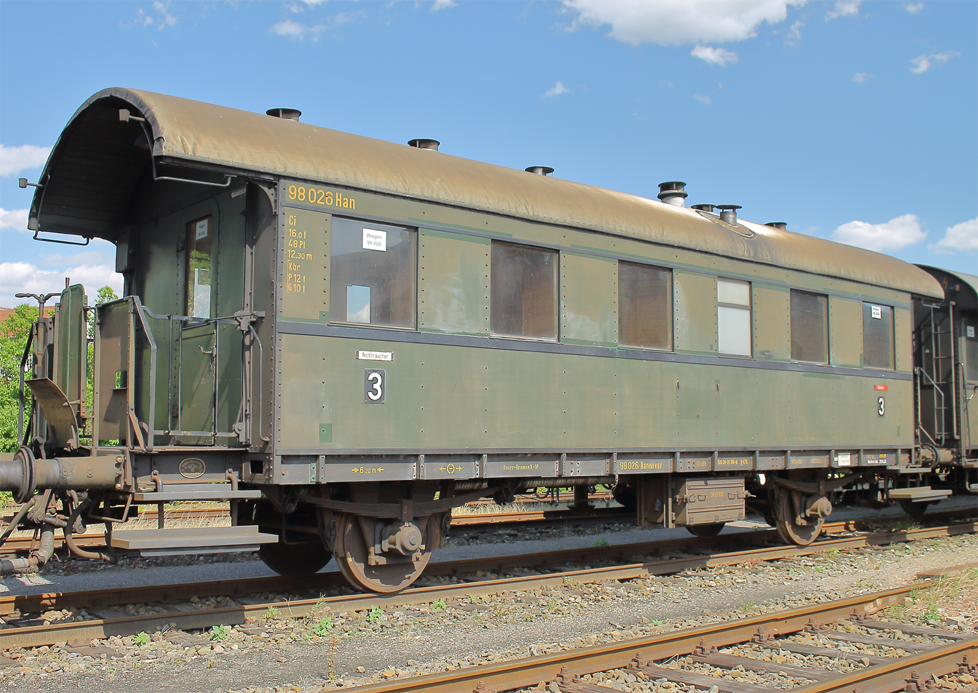
Our 98 026 was built by
Waggon- und Maschinenbau AG Görlitz in 1929. It was delivered to the
Kleinbahn Freienwalde-Zehden (KFZ) in 1930 as a 3rd-class passenger
coach. From drawings of the class Ci-25, the construction of the class
follows the pattern of 2-axle gangwayed carriages for secondary lines
of the Deutsche Reichsbahn Gesellschaft (DRG). Nevertheless certain
components, for example the windows, were built according to the
production rules of 1929. The heating departed from Reichsbahn
practice by using circulating water heated by a separate boiler. To
accommodate this, the 3 sets of seats opposite the toilet were
dispensed with and in their place stood the boiler. Similarly,
lighting was not provided by an on-board generator but by a supply
from the baggage coach, a common practice on the KFZ. Also noticeable
are the Flettner ventilators and the roof-mounted water tank. Remember,
too, that this 3rd-class coach had a flushing toilet and a hand-basin
with running water – something you would not find in similar carriages
on the DRG. Scheduled use of the coach came to an end on 25 May
1968. After passenger travel ceased, the carriage was robbed of its
heating equipment and the non-smoking- compartment was stripped of its
interior fittings. The coach became a baggage and service vehicle on
the KWD and was bought in Summer 1980 by the Dampfeisenbahn
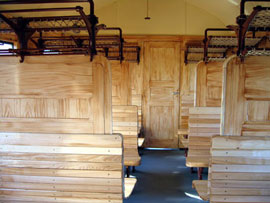
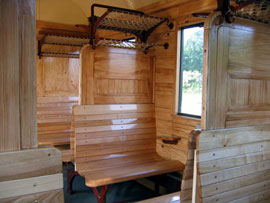
Weserbergland e.V. (DEW) in Rinteln. In Rinteln seating was returned
to the non-smoking compartment, although unfortunately this was not in
the original style. Windows were replaced, the water tank removed and
the wooden roof replaced by a new canopy. In this ‘preserved’
condition the DEW ran the coach, now numbered 25, on its line from
Rinteln to Stadthagen from 1982 to 2000. As a result of revision of
its needs, the DEW put the carriage up for sale early in 2001 and was
bought by Eisenbahn-Tradition e.V. on 29 June that year. After
overhaul of the bodywork and running gear during Autumn 2001 and
Winter 2002, the carriage first ran in the Teuto-Express on Ascension
Day 2002 between Bielefeld and Halle (Westf.). Before the following
Winter season, the hot-water heating was reinstalled and the smoking
compartment revarnished. For Summer 2004 the non-smoking compartment
is to get its original wooden seats and half-height compartment
dividing walls. Further restoration work will continue with the toilet
and the fitting of the water tank on the roof. |
 |
|
Type |
Ci-25 |
|
Manufacturer |
WUMAG Görlitz |
|
Year |
1929 |
|
Lenght over buffers |
12.300 mm |
|
Total weight |
16,0 t |
|
Brake type |
Kbr |
|
Seats |
48 - 3rd class |
|
Max speed |
90 km/h |
|
Status |
Serviceable |
|
|