|
 Our Class 50 began life on
15 July 1942 in the Borsig-Lokomotivwerken in Berlin and went into
service on the Reichsbahn. It was numbered 50 2220 ÜK, the ÜK
signifying Übergangskriegslok, a simplified design due to the
conditions imposed by the war. She remained in the ‘Soviet Zone’ after
1945. As the boiler was not made of St47K steel (a more durable type,
able to better withstand the stresses of a locomotive boiler), and as
the DDR could not do without its steam locomotives, the loco was
chosen for the extensive rebuilding programme in 1961. She emerged in
March / April of that year as ‘new’ Rekolok 50 3655; to improve
efficiency the boiler now incorporated a combustion chamber and a
feed-water heater (Mischvorwärmeranlage) extracted waste heat from
exhaust steam which altered her appearance. In this form she served
until 1986 at the railway works in Karl Marx Stadt and until the early
1990s she earned her keep as a ‘rolling boiler’. Eisenbahn-Tradition
e.V. was looking for a Class 50 in 1992, and discovered her in the
locomotive graveyard at Chemnitz-Hilbersdorf among numerous other
Class 50.35 and Class 52.80 locos. With no connecting- or
coupling-rods, with much missing pipework, pumps and valves, and
covered in rust, she was in a sorry state. Nevertheless her boiler
appeared good and the running gear was complete. Although the ‘wreck’
was bought for DM 10,000 (~5,000 €), it cost a further DM 150,000
(~75,000 €) and over 3000 hours’ work to put her back into service.
Along with many railway fans, we have to thank the Sparkasse
Ibbenbüren for donating much of the money. Our own members – all
volunteers - undertook the restoration work. To keep her in service
swallows up in the region of 50,000€ per year. This is to cover not
only running costs but also to make provision for major inspections
and renewals. In the winter of 2001 the running gear was inspected and
overhauled – at a cost of DM 250,000 (~125,000 €). Early in 2004 we
began the extensive work to prepare the loco for its boiler inspection,
and she came back into service in 2005. Our Class 50 began life on
15 July 1942 in the Borsig-Lokomotivwerken in Berlin and went into
service on the Reichsbahn. It was numbered 50 2220 ÜK, the ÜK
signifying Übergangskriegslok, a simplified design due to the
conditions imposed by the war. She remained in the ‘Soviet Zone’ after
1945. As the boiler was not made of St47K steel (a more durable type,
able to better withstand the stresses of a locomotive boiler), and as
the DDR could not do without its steam locomotives, the loco was
chosen for the extensive rebuilding programme in 1961. She emerged in
March / April of that year as ‘new’ Rekolok 50 3655; to improve
efficiency the boiler now incorporated a combustion chamber and a
feed-water heater (Mischvorwärmeranlage) extracted waste heat from
exhaust steam which altered her appearance. In this form she served
until 1986 at the railway works in Karl Marx Stadt and until the early
1990s she earned her keep as a ‘rolling boiler’. Eisenbahn-Tradition
e.V. was looking for a Class 50 in 1992, and discovered her in the
locomotive graveyard at Chemnitz-Hilbersdorf among numerous other
Class 50.35 and Class 52.80 locos. With no connecting- or
coupling-rods, with much missing pipework, pumps and valves, and
covered in rust, she was in a sorry state. Nevertheless her boiler
appeared good and the running gear was complete. Although the ‘wreck’
was bought for DM 10,000 (~5,000 €), it cost a further DM 150,000
(~75,000 €) and over 3000 hours’ work to put her back into service.
Along with many railway fans, we have to thank the Sparkasse
Ibbenbüren for donating much of the money. Our own members – all
volunteers - undertook the restoration work. To keep her in service
swallows up in the region of 50,000€ per year. This is to cover not
only running costs but also to make provision for major inspections
and renewals. In the winter of 2001 the running gear was inspected and
overhauled – at a cost of DM 250,000 (~125,000 €). Early in 2004 we
began the extensive work to prepare the loco for its boiler inspection,
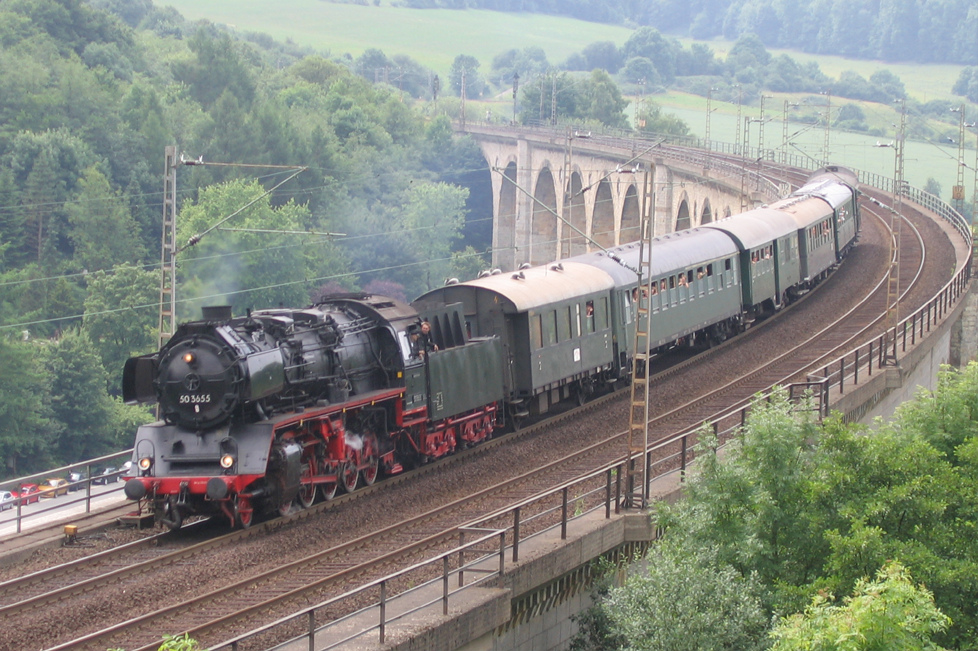
and she came back into service in 2005.

|
 |
|
Type |
G56.15 / 50.35-37 |
|
Manufacturer |
Borsig in Berlin |
|
Production N° |
15214 |
|
Year |
1942 (als 50 2220 ÜK) |
|
Rekonstruction |
1961 (RAW
Stendal) |
|
Lenght over buffers |
22.940 mm |
|
Total weight |
140,0 t |
|
Power |
1760 PSi |
|
Boiler pressure |
16 kp/cm² |
|
Driving-wheel diameter |
1.400 mm |
|
Max speed |
80 km/h (forw. a.
backw.) |
|
Coal- / water supply |
8
t / 26m² |
|
Last company number |
50
3655-3 |
|
Status |
in
refurbishment |
|
|