|
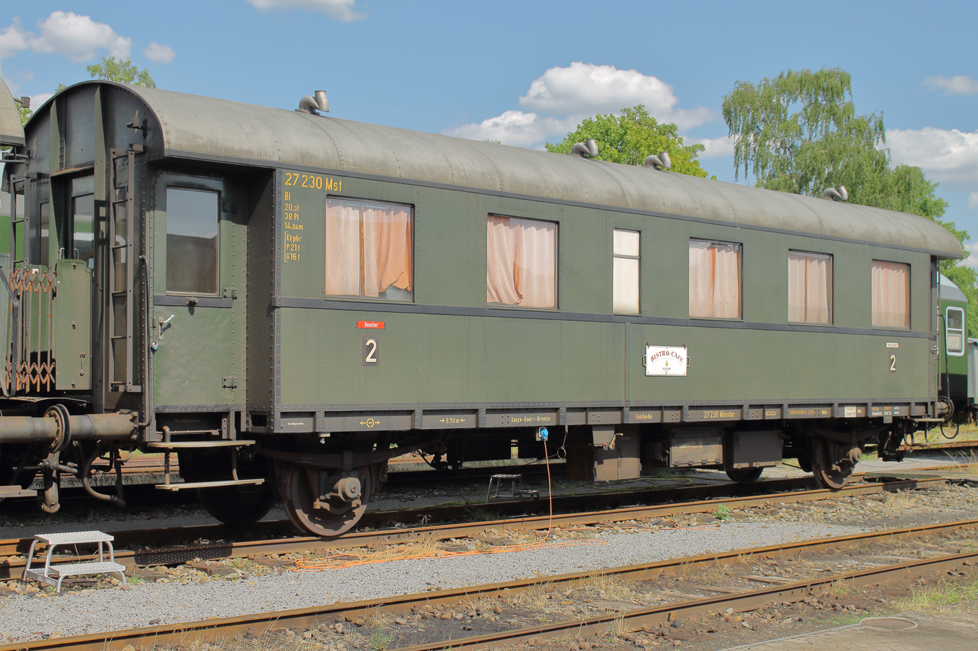
The Bi-29 type was
developed to supplement the 2-axle Standard Corridor coach (‘thunder-boxes’).
However, to protect 2nd class passengers from draughts, an enclosed
entrance replaced the open end platform. The company Gebr. Schöndorff
AG in Düsseldorf built 27 230 in 1929, after which it ran in service
until 1965 with Deutsche Bundesbahn. From then, for a further quarter
of a century, it was then rebuilt to serve railway staff as living and
sleeping accommodation. Windows were pan-elled over and welded up,
seats removed and beds, cupboards and wash-basins installed. The
exterior was painted blue. It was finally taken out of service in
1990.This carriage is typical of those in our historic train. In 1990
it was clear that the 4 wooden-bodied TWE carriages we had been using
were, from a safety point of view, no longer fit for service on the
line. So we took a decision to build up a train from steel-bodied
stock. Carriage 27 230 escaped scrapping at Osnabrück in 1990 and we
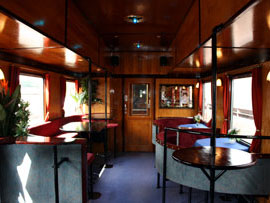
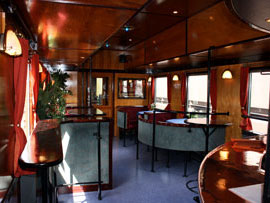
began its conversion into our beloved ‘Bistro-Café’. The interior was
modelled on the (then) only 5-year old Bistro-café carriages found in
Inter-Regio trains on DB. Outwardly the carriage it appears in its
original form. Typical details are the end ladders and signal lamp
holders at the ends and its designation as a 2nd class passenger coach
of 1950, quite in keeping with the other stock.
In the years 2006-2009, the
wagon was fundamentally refurbished with the help of the Friends of
Teuto-Express. After extensive work on the chassis and car body with
repainting, the work on the interior was almost equivalent to a new
building. Since September 2009, the popular bistro car has once again
been available to our passengers as the gastronomic centre of our
train.
 |
 |
|
Type |
Bi-29 |
|
Manufacturer |
Gebr. Schöndorff AG,
Düsseldorf |
|
Year |
1929 |
|
Lenght over buffers |
14.040 mm |
|
Total weight |
20,3 t |
|
Brake type |
Kk G-P |
|
Max speed |
90 km/h |
|
Status |
Serviceable |
|
|